Best Interactive Games for a Dinner and Dance in Singapore
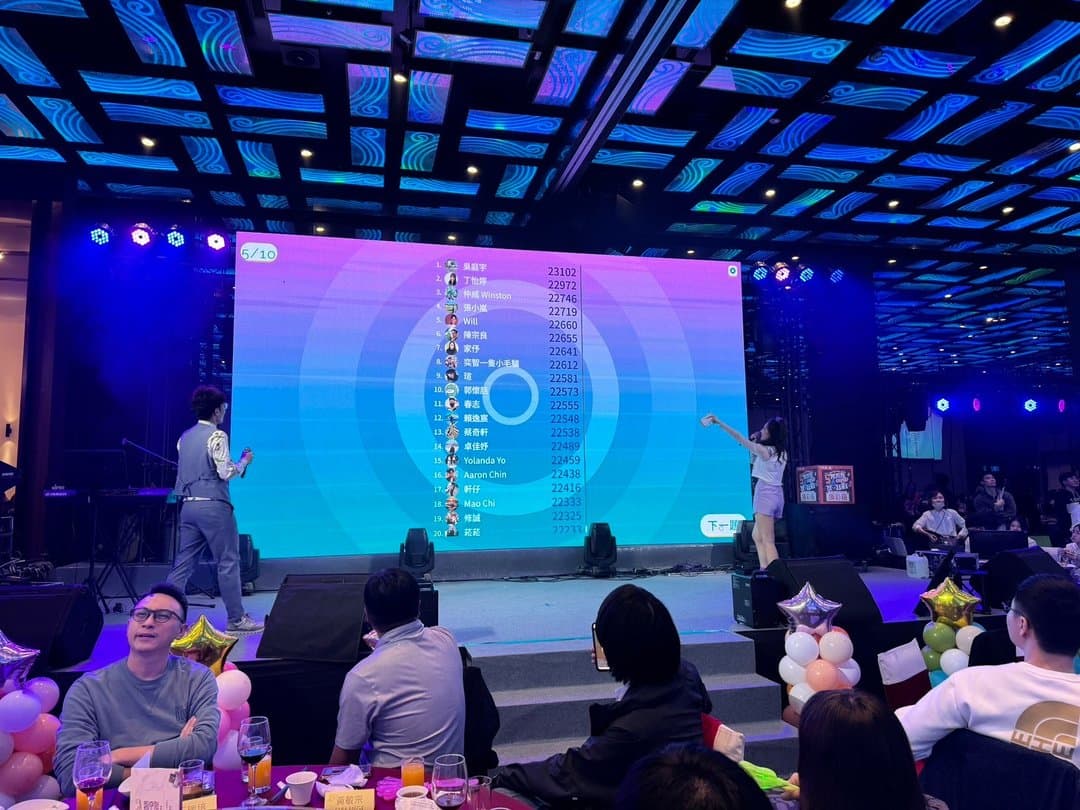
Interactive games for a Dinner and Dance (DND) in Singapore have one job: get 200, 500 or 1,000 seated guests doing the same thing at the same moment, without anyone leaving their table. That is exactly where most DND games fail. A stage game with five volunteers entertains five people. A quiz app that needs a download and a game PIN loses half the ballroom before the first question. This guide covers the big screen games that actually scale to a full corporate event, how they compare with Kahoot-style tools and stage games, and how to fit them into the run-of-show.
What counts as a big screen game at a corporate event
A big screen game runs on two surfaces at once. The ballroom LED wall or projector shows the shared game state and the live leaderboard; every guest’s own phone is the controller. Guests scan a QR code printed on the table card or shown on screen, the game opens in the phone browser, and they are in — no app, no account, no nickname or PIN to type. Because nothing is installed, there is no cap on how many people play at the same time. That is the difference between a game for one table and a game for the whole room.
Interactive games for a DND: how the options compare
Before choosing a specific game, decide which format you are buying. Each one trades off reach, control and effort differently.
- Stage games with volunteers: a handful of guests on stage, everyone else watching. Fine as a five-minute segment, but it does not count as engagement for the other 490 people.
- Classroom quiz tools (Kahoot, Slido and similar): built for meetings and lessons, not ballrooms. Guests type a PIN and a nickname, player limits depend on the plan tier, the look is generic, and there is nobody on site if the projector feed drops.
- Emcee-led table games: no equipment, but also no leaderboard. Judging fifty tables by eye is slow and always feels unfair to someone.
- Big screen phone games: the whole room plays at once from their own phones, the leaderboard is live and automatic, the visuals carry your brand, and an on-site crew runs the tech so the emcee only has to talk.
The five games that work for 200+ guests
These are the formats we run most often at Singapore DNDs, product launches and annual celebrations. All five join by QR code with no app, run on an indoor stage with a big screen, and can be branded with your key visual.
Live quiz. Your own question bank — company milestones, product knowledge, department in-jokes — with text, image, audio and video questions supported. Everyone answers on their phone against a countdown, and the system ranks players by accuracy and reaction time, refreshing the leaderboard on the big screen after every round. Best slot: the opening warm-up, or between speeches when attention drifts.
Phone-shake race. Tables are grouped by department, branch or table number, and everyone shakes their phone to send their team’s balloon up the screen. The harder the table shakes, the higher it climbs, with a live data wall showing the rankings. Rounds can be replayed, so a best-of-three works well. Best slot: right after mains are cleared, when the room is full but energy dips.
Live group Tetris. Each guest’s phone becomes a controller and the big screen shows a live top-ten leaderboard. Game duration and speed are adjustable, so you can run a timed challenge for a prize, and the background theme, block colours and score display can match your brand. It can also collect a participant list through QR sign-up if marketing wants one. Best slot: a timed challenge with a named prize.
Galaxy Battle (retro shooter). Every guest pilots their own fighter — slide to dodge, tap to fire — and the big screen live-broadcasts the actual game views of the current top three players, so the room watches every overtake. The fighter, aliens and background can be swapped for your mascot or event theme. Supports multiple rounds and team battles. Best slot: a high-energy segment before the lucky draw.
Retro Snake Battle. The rules fit in one sentence — eat, grow, do not crash — which is why it works for mixed-age rooms and family days as well as DNDs. Arrow controls sit at the bottom of the phone screen; the big screen broadcasts the top three snakes live. Board and snake colours take your brand. Best slot: a light filler segment with small prizes.
How to plan DND games into the run-of-show
- 01Pick two or three games, not six. Mix formats: one quiz, one physical (phone-shake), one arcade (Tetris, Galaxy or Snake).
- 02Decide the team structure early — by department, branch or table — because the phone-shake race is set up around it.
- 03Write the quiz questions two weeks out. Mix genuine company questions with easy ones so every table scores something.
- 04Put the join QR on the table cards and on screen, and have the emcee walk the room through scanning before the first act, not during it.
- 05Attach a prize to every game and decide how winners are announced — on the leaderboard, or handed to the lucky draw list.
- 06Rehearse once with the venue AV team during setup: screen feed, sound cue, emcee cue.
What to prepare on site
- A big screen or projector on an indoor stage, with a video feed for the game station
- A stable internet line for the game station; guests play on their own mobile data, so venue Wi-Fi is not the bottleneck
- Table cards or screens showing the join QR code
- An emcee with a short script for each game: how to join, the rule in one sentence, the prize
- Prizes ready at the stage so winners are called up immediately
- On-site crew to run the games, which is included in the service
Which games fit which corporate event
- Company DND, 300–1,000 pax: live quiz to open, phone-shake race after dinner, then the lucky draw as the finale
- Product launch: a live quiz built on product knowledge, plus Galaxy Battle with your product or mascot as the fighter
- Annual celebration or town hall: a timed Tetris challenge between segments, one prize per round
- Family day or brand carnival: Snake and Galaxy, because grandparents and kids pick them up in seconds
- Team bonding, 50–150 pax: the phone-shake race by team, best of three
Every game above is quoted per event, not per head — the price depends on date, venue, headcount and how much branding you want. WhatsApp us with your date, venue and headcount and we will suggest a game mix and a custom quote, usually within one business day.
FAQ
For a seated ballroom of 200 or more, the games that reliably work are big screen phone games: a live quiz with company questions, a phone-shake race between tables, and arcade battles such as live Tetris, Galaxy Battle or Retro Snake. All join by QR code with no app and show a live leaderboard on the big screen.
There is no player cap. Guests join through the phone browser rather than an installed app, so a 1,000-guest DND can play the same round at the same time.
No. Guests scan a QR code on the table card or screen and the game opens in their phone browser — no app, no account, no PIN.
Classroom quiz tools work for small meetings but are awkward in a ballroom: PIN and nickname entry, plan-based player limits, generic visuals and no on-site support. A big screen game is built for the event format — unlimited players, brand visuals, a live leaderboard and a crew running the tech.
An indoor stage with a big screen or projector, a video feed for the game station and a stable internet line. Guests use their own mobile data. Pixanity brings the game station and crew, islandwide across Singapore.
Two or three, spread across the night: one to warm up, one after dinner, and the lucky draw as the finale. More than that and the games start competing with the performances and speeches.
MORE GUIDES
360 Photo Booth Singapore Price Guide: Video vs Photo, Space, Add-ons (2026)
What a 360 photo booth in Singapore costs in 2026 and what drives the price: the difference between a 360 video booth and a photo booth, how much floor space the platform needs, group capacity, and the add-ons (custom overlay, props, backdrop, extra hours) that change a 360 booth rental quote.
AI Photo Booth Singapore: What It Is, Price, and How to Choose (2026)
A practical guide to the AI photo booth in Singapore for 2026: what a generative AI photo booth actually does, the four modes (outfit swap, caricature, background swap, beauty), what AI photo booth rental costs, how it compares with a traditional booth, and how to plan one for a Dinner and Dance, launch or roadshow.
How to Run a Cashless Carnival and Stamp Rally in Singapore
How to run a cashless carnival in Singapore with QR points and a digital stamp rally: physical carnival tokens vs QR, vendor settlement, stamp checkpoints, point rules and what to prepare on site.
Tell us your event type, date and headcount
We’ll recommend a setup and a custom quote from real event experience.
Get a quote